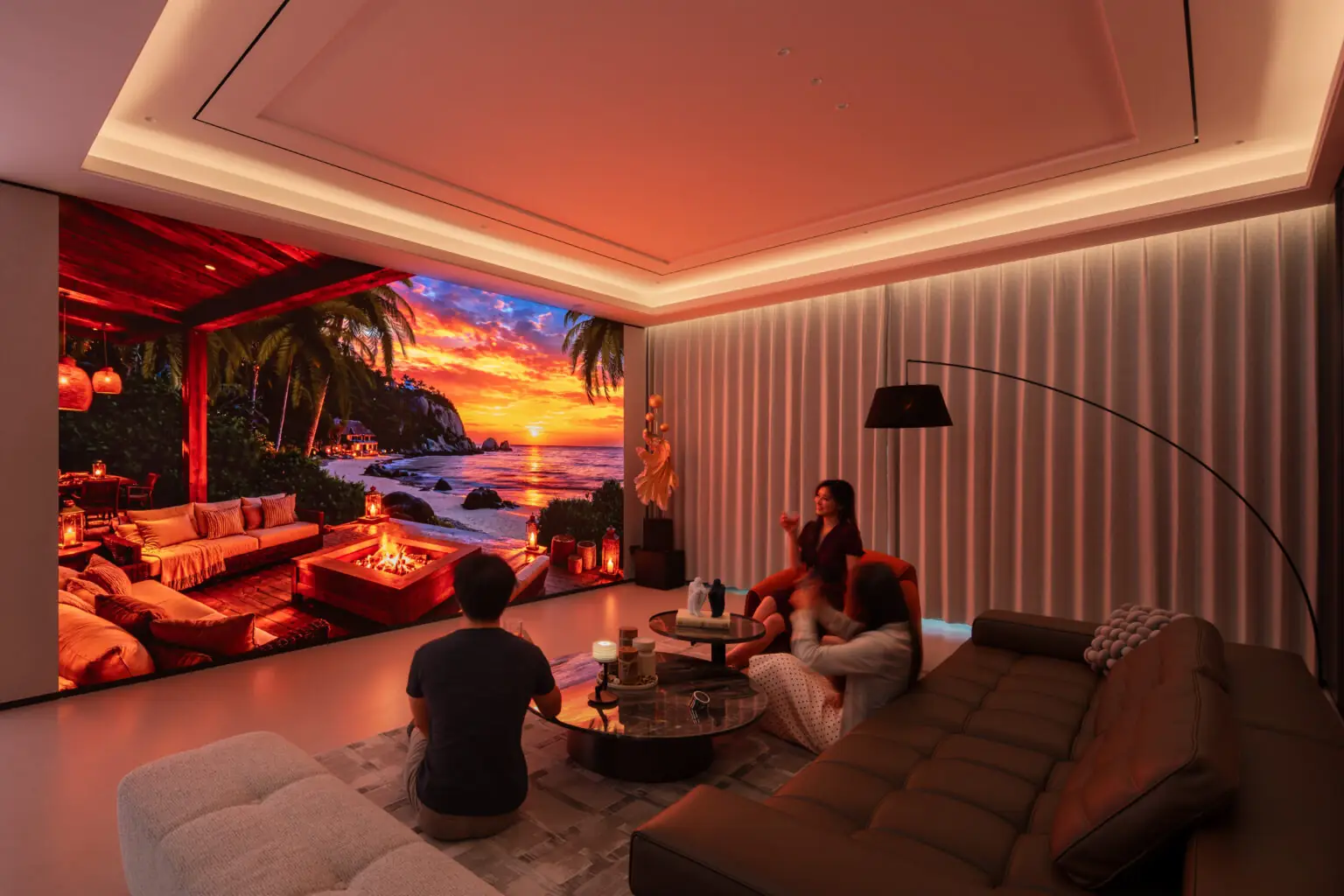
Movie rooms, multipurpose lounges, and luxury entertainment spaces can require very different display budgets. Video wall for home planning should therefore begin with the intended viewing experience rather than a fixed screen size. Seating distance, room proportions, content type, and desired immersion all influence how much display technology makes practical sense.
Ledman’s residential Micro LED technology focuses on high-definition image reproduction, combining high contrast, high refresh rate, 120% DCI-P3 wide color gamut, and broad viewing angles. These characteristics can preserve brightness, color richness, and fine image details across different seating positions, making the technology relevant to premium private cinema environments.
Screen dimensions still represent only one part of the investment. Processing hardware, audio equipment, installation work, electrical preparation, room treatment, and furniture can substantially change the final project cost.
Entry-Level Budget Priorities
Smaller entertainment spaces can often work with moderate display dimensions and straightforward installation. The main objective should be matching screen scale with viewing distance, since excessive size may create an uncomfortable viewing angle while insufficient size can reduce cinematic impact.
Source equipment also deserves careful selection. Streaming devices, gaming consoles, media players, and Blu-ray equipment each introduce connectivity requirements. A basic processor and suitable HDMI infrastructure may be sufficient for relatively simple systems, while multiple sources can call for additional switching hardware.
Audio should not be overlooked simply because the display receives most of the visual attention. Speaker placement, amplifier capacity, and room acoustics influence dialogue clarity and spatial effects. Spending the entire budget on the screen can leave the rest of the viewing environment underdeveloped.
Mid-Range Systems And Practical Upgrades
Mid-range projects generally benefit from more balanced allocation. A home video wall may sit alongside a stronger audio system, better source management, automated lighting, and improved cable organization. These additions can make the entertainment space easier to operate without requiring extensive architectural modification.
Room treatment becomes increasingly valuable as the display and audio system become more capable. Hard flooring, bare walls, and large glass surfaces can produce unwanted sound reflections. Curtains, rugs, acoustic panels, and carefully selected furnishings can help create more controlled listening conditions.
Furniture choices should correspond with viewing habits. Deep seating can suit long movie sessions, while modular arrangements may work better in rooms used for gaming, sports, and social gatherings. Seating height also affects sightlines, particularly when several rows are involved.
Premium Display Investment
Large residential installations usually involve more than purchasing a screen. Structural preparation, delivery access, electrical capacity, ventilation, cable pathways, and equipment placement may all affect installation expenditure. Architectural integration can raise labor costs further if the display is intended to appear as part of the wall rather than as an independent fixture.
Premium Micro LED technology can also shift the budget toward image performance. High contrast supports darker cinematic scenes, while high refresh rates can improve the appearance of fast-moving content. Wide color reproduction is particularly relevant to films with rich gradients, natural landscapes, or carefully graded skin tones.
Screen technology should therefore be evaluated according to the room and content library. Buyers who mainly watch standard television may have different priorities from users building a dedicated cinema around high-resolution movies and console gaming.
Installation And AV Equipment
Installation complexity often remains hidden during early budgeting. Wall reinforcement, custom framing, electrical work, network cabling, rack construction, and calibration can each add separate costs. Difficult delivery routes may create additional logistical requirements for oversized equipment.
A video wall for home also needs suitable signal management. Multiple content sources may require switching, distribution, or signal conversion, while higher-resolution sources can place greater demands on processing hardware. Compatibility should be reviewed before purchasing individual components.
Control systems introduce another variable. Basic remote controls may suit smaller setups, whereas integrated automation can connect display functions with lighting, curtains, audio, and other room systems. Such convenience has a cost, but it can be worthwhile in spaces designed around frequent entertainment use.
Room Treatment And Furniture Costs
Visual quality depends partly on the environment surrounding the screen. Ambient light can reduce perceived contrast, especially during dark scenes, so blackout curtains or controlled lighting may become useful investments. Lighting placement also matters because fixtures positioned directly opposite the screen can create distracting reflections.
Acoustic treatment follows a similar principle. Rather than filling every surface with panels, room design can target major reflection points and problematic frequencies. Proper speaker positioning, bass management, and suitable furnishings may contribute as much to perceived sound quality as additional audio hardware.
Furniture completes the physical viewing environment. Seating distance should correspond with screen size, while sightlines need to remain clear for every intended position. A larger budget does not automatically require extravagant furniture; comfort, durability, and spatial efficiency remain more relevant than appearance alone.
Building A Realistic Total Budget
Cost comparisons become more meaningful once every category is listed separately. Display hardware forms the central investment, but AV equipment, installation, electrical preparation, lighting, acoustic work, furniture, and control systems can collectively represent a substantial share of the project.
For many homeowners, home video wall planning works best through staged priorities. Screen dimensions and viewing distance can be settled first, followed by source connectivity and audio. Room treatment, automation, and furniture can then be assessed according to how much they contribute to the intended experience.
Premium projects require particularly careful coordination because architectural work and display installation may depend on each other. Budgeting early for measurements, access conditions, wiring, and structural requirements reduces the likelihood of expensive changes later.
Conclusion
Residential display budgeting is less about finding one universal price and more about understanding how individual decisions interact. Screen technology affects image performance, room conditions shape what viewers perceive, and supporting equipment determines how easily the system handles different forms of content. Video wall for home projects can range from relatively focused media-room installations to highly integrated private cinemas, so the appropriate investment depends on space, usage, and expectations. Ledman’s high-contrast, wide-color-gamut Micro LED approach illustrates how display performance can become one part of a broader residential entertainment design rather than the sole measure of value.