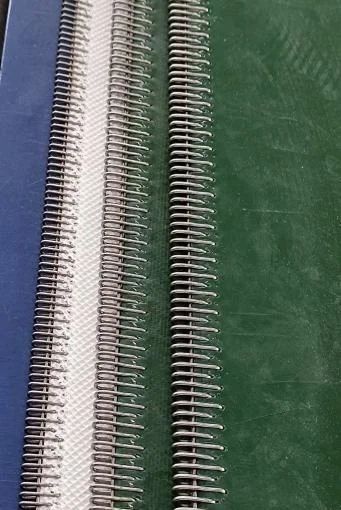
Mechanical belt splicing gives maintenance teams a practical alternative to permanent joining methods when conveyor belts need to be installed, repaired, or replaced. For many light-duty industrial applications, the fastening system needs to balance joint flexibility, installation requirements, belt compatibility, and maintenance access. Properly selected conveyor belt lacing uses mechanical fasteners to join prepared belt ends while allowing the splice to function within the conveyor system.
For manufacturers and maintenance departments, wire hook fastening can be particularly useful when belts require regular servicing. Instead of treating the splice as a permanent connection, a mechanical system can provide a more manageable approach to belt replacement and repair. The actual selection still depends on belt thickness, fastener configuration, pulley diameter, operating conditions, and the installation process.
How Conveyor Belt Lacing Supports Mechanical Splicing
Wire hook fastening systems use rows of formed hooks that are attached to the belt ends and connected across the splice. The completed joint is designed to move with the belt rather than creating a completely rigid connection. This can be useful where the belt repeatedly travels around conveyor pulleys.
The main benefit for maintenance teams is flexibility in handling belt service. Mechanical splices can generally be installed without the curing time associated with some bonded joining methods, making them practical for applications where maintenance access and repair scheduling are important. The exact installation process depends on the selected fastener and equipment, so technicians need to follow the applicable manufacturer instructions.
Another consideration is belt thickness. A fastening system designed for a thin belt may not be appropriate for a thicker belt, while an oversized fastener can create unnecessary installation challenges. Procurement teams should therefore begin with accurate belt measurements before selecting the fastening configuration.
Matching the Conveyor Belt Lace to Belt Specifications
A conveyor belt lace should be evaluated according to the complete belt and conveyor specification rather than by appearance alone. Important parameters include belt thickness, wire diameter, pin diameter, fastener material, and minimum wheel diameter.
Intake’s official Reinforced Wire Hook Belt Fastener page lists 304S as the material, a product weight of 0.55 kg, and packaging of 12 pieces per box. Its specification table provides multiple configurations for different belt applications. For example, model 86047 uses a Φ1.0 wire diameter, a Φ1.5–Φ1.7 pin, and is specified for 1.6–3.2 mm belt thickness with a 51 mm minimum wheel diameter. Model 86048 uses Φ1.4 wire, a Φ2.3–Φ2.4 pin, covers 3.2–4.5 mm belt thickness, and has an 89 mm minimum wheel diameter.
Other options extend into thicker belt applications. The page lists model 86049 for 4.5–6.4 mm belt thickness and model 86050 for 5.6–6.4 mm, both using 304S. The same product page also lists 316L configurations and selected Hastelloy C-276 models for different requirements.
These differences matter when businesses purchase fastening components in volume. Selecting a product according to the exact belt specification can reduce the risk of ordering a configuration that does not match the intended conveyor.
Installation and Maintenance Considerations
A mechanical splice performs as part of a complete system, so installation quality is just as important as component selection. Belt ends need to be prepared and aligned correctly before the fasteners are installed. The selected installation method should also correspond with the fastener design and production requirements.
For manufacturers producing washing belts, filter mesh belts, or other light industrial conveyor products, repeatability can be an important consideration. Consistent belt preparation and fastening procedures can help operators achieve more uniform joints across production batches.
Maintenance teams can also benefit from maintaining records of the belt construction, fastener model, pin specification, and conveyor pulley dimensions. When a replacement is required, these records provide a starting point for identifying a compatible component instead of relying on visual comparison.
Mechanical fastening can also support easier belt servicing in appropriate applications. Because the splice is assembled mechanically, technicians can work with individual components rather than treating the entire belt as a permanently joined assembly. However, the suitability of this approach depends on the belt, conveyor design, and operating conditions.
Building a Practical Mechanical Splicing Strategy
For B2B buyers, the value of conveyor belt lacing lies in how well the fastening system matches the actual production or maintenance requirement. Belt thickness, minimum pulley diameter, fastener material, and installation method should be reviewed together before procurement.
Intake provides reinforced wire hook fasteners alongside carded wire fasteners, hinge pins, the INTAKE CR Series, and manual and hydraulic installation equipment. This product range gives manufacturers, distributors, and maintenance teams options for building a fastening system around specific belt requirements.
For industrial users, a specification-based approach makes mechanical splicing easier to manage. Matching the wire-hook system to the belt and conveyor conditions can support consistent installation, practical maintenance, and more organized replacement planning.