Construction customers rarely need the same combination of lifting height, capacity, reach, and terrain performance. A dealer therefore needs more than a single machine to address varied jobsites. An off road telehandler can serve projects where materials must be lifted and placed across uneven ground, but the right product mix should cover different capacity and reach requirements. Understanding these application differences helps dealers organize a lineup around actual purchasing needs.
Start With the Customer’s Material-Handling Tasks
The first step is to identify what buyers expect the machine to handle. Construction projects may involve pallets of bricks, roofing materials, formwork, concrete-related materials, or other loads that must be transported and positioned at different elevations. Weight, lift height, forward reach, and placement accuracy can change significantly from one application to another.
Dealers can segment demand by capacity and reach rather than relying only on engine size or machine dimensions. A compact model may suit lower-height material handling, while larger machines are better aligned with high-level placement. This approach also helps sales teams explain why two machines with similar rated capacities may serve very different construction requirements.
Build Around Lift Height and Reach
Lift height and forward reach should be evaluated together. A machine may have substantial maximum lifting capability but offer a much lower capacity when the boom is extended forward. Buyers should therefore examine capacity at different boom positions rather than treating the headline rated capacity as applicable to every task.
An off road telehandler also needs to match the physical layout of the jobsite. Dealers should discuss ground conditions, travel routes, turning space, required clearance, and working areas before recommending equipment. A machine that reaches the target location but cannot maneuver effectively through the site may not provide the expected operational value.
Match the Machine to Jobsite Conditions
Construction sites can change rapidly as buildings, foundations, roads, and temporary access routes develop. Ground conditions may include compacted soil, gravel, slopes, or unfinished surfaces. Dealers should therefore understand the relationship between tire configuration, ground clearance, traction, steering modes, frame leveling, and machine dimensions.
These considerations are especially relevant when customers operate in outdoor environments. An off road telehandler should be assessed according to the terrain and load placement requirements of the actual project. Buyers should also confirm operating limitations, manufacturer instructions, and applicable site procedures instead of assuming that every telehandler has the same terrain capability.
Use Attachments to Broaden the Mix
A telehandler’s usefulness can extend beyond standard fork handling when compatible attachments are available. Depending on the machine and manufacturer, buyers may consider attachments designed for specific material-handling or placement tasks. Dealers can use attachment availability as another way to organize their product offering around application requirements.
However, an attachment should never be treated as an automatic capacity upgrade. The machine must be approved for the particular attachment and load configuration, and the applicable load chart must be followed. OSHA emphasizes checking the appropriate rated-capacity information for the equipment configuration and application before operation.
Make the Product Mix Easy to Compare
Dealers can simplify purchasing discussions by presenting machines with clearly differentiated specifications. Useful comparison points include rated capacity, lift height, capacity at maximum height, maximum forward reach, capacity at maximum reach, machine weight, overall dimensions, turning radius, and steering configuration.
This information allows buyers to connect equipment specifications with specific construction tasks. Instead of presenting several machines with overlapping descriptions, dealers can explain which applications each model is designed to address. A structured lineup can also make it easier for customers to move between entry-level, mid-range, and high-reach requirements as their projects change.
The Zoomlion ZTH4018 in a Dealer Lineup
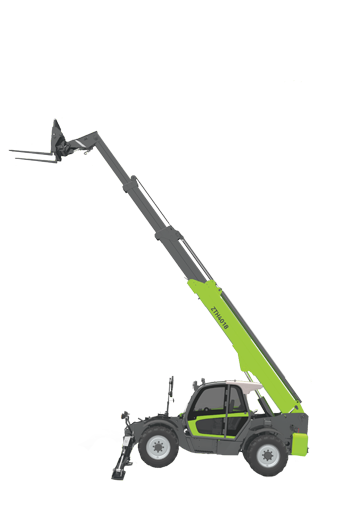
The Zoomlion ZTH4018 is a non-rotating telehandler with a 17.6 m maximum lift height and 4,000 kg rated capacity. Zoomlion Access lists a 2,500 kg lift capacity at maximum height and a 13.4 m maximum forward reach, where the listed capacity is 850 kg. These figures give dealers specific reference points when discussing high-reach construction material placement.
The machine measures 6.48 m long, 2.28 m wide, and 2.57 m high, with a 0.42 m minimum ground clearance and a 3.8 m outside turning radius. It uses a hydraulic transmission and offers front-wheel, four-wheel, and crab steering modes. The published specification also lists 400/80R24 tires, a 71 kN maximum traction force, and ±10° frame leveling.
Why Zoomlion Access Offers Multiple Options
Zoomlion Access currently lists eight telehandler models, including non-rotating machines ranging from the ZTH2506 to the ZTH4018, as well as rotating models such as the ZTH4518R and ZTH4525R. Across the listed range, maximum lifting heights extend from 6 m to 24.8 m, while rated capacities range from 2.5 to 4.5 tonnes.
The broader portfolio can help dealers structure products around different customer requirements rather than relying on one machine category. The Zoomlion ZTH4018 can occupy a higher-reach position within that lineup, while other models address lower lifting heights or different capacity requirements. Zoomlion Access also lists telehandler attachments alongside its equipment range, providing another consideration for dealers developing application-focused offerings.
Building a Balanced Dealer Offering
A successful telehandler product mix should reflect the jobs customers actually perform. Dealers can start with common capacity bands, then add models for higher lifting, longer forward reach, rougher terrain, or specialized attachment requirements. This creates a clearer path for customers to compare equipment according to application rather than choosing solely by maximum capacity.
The Zoomlion ZTH4018 provides one example of a high-reach, 4,000 kg-rated machine within a broader telehandler range. For dealers evaluating an off road telehandler lineup, comparing lift height, reach, capacity at working positions, dimensions, steering, and available configurations can create a more practical product structure. Zoomlion Access provides multiple telehandler classes that dealers can assess against their local construction-market requirements.