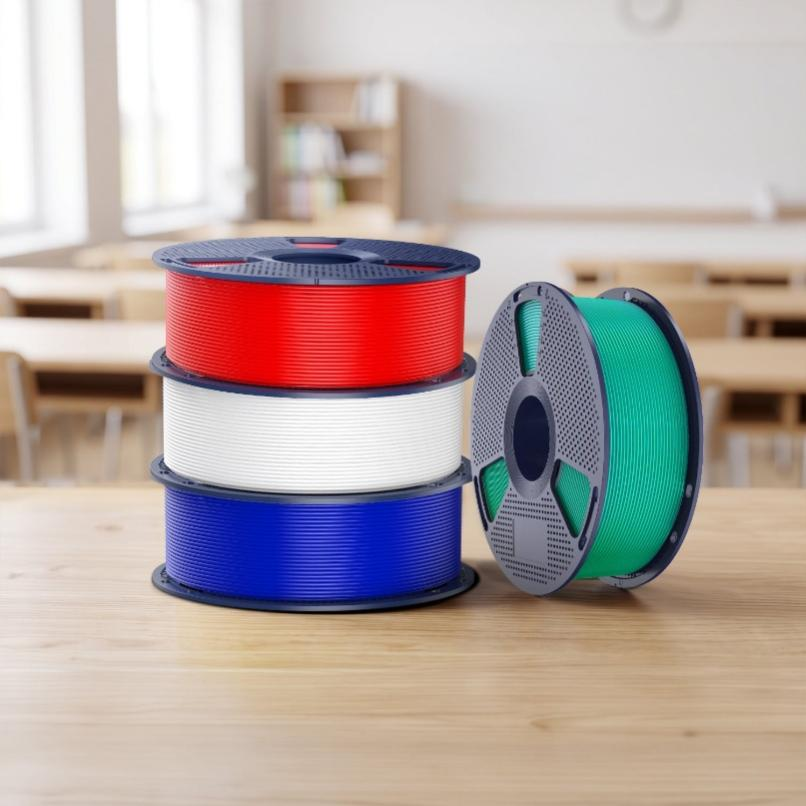
Yes, PLA+ can be a practical starting point for new FDM users, but beginner-friendly does not mean every printer will produce the same result without adjustment. The learning curve is usually manageable because PLA plus ws familiar PLA printing principles, while its tougher formulation can suit functional parts as well as models. New users still need to understand first-layer adhesion, temperature, extrusion, cooling, and filament storage.
SUNLU’s current PLA+ product information lists 1.75 mm filament with dimensional accuracy of ±0.02 mm and provides starting ranges for nozzle temperature, speed, bed temperature, drying, and humidity control. These values give beginners a reference for initial setup rather than requiring them to guess at every setting.
Why PLA+ Is Accessible for New Users
PLA is commonly used as an introductory FDM material. Prusa describes PLA as one of the easiest materials to print and suitable for beginners. UltiMaker also describes PLA as versatile and easy to 3D print, with uses including detailed models, prototypes, jigs, and gauges.
PLA+ uses the same basic extrusion process: the printer heats the filament, feeds it through the nozzle, and builds the object layer by layer. A beginner therefore does not need to learn a different printing method when moving from ordinary PLA to PLA+.
However, a PLA+ profile should still be treated as material-specific. Different formulations can respond differently to temperature, cooling, extrusion rate, and speed.
SUNLU PLA+ Starting Settings
The current SUNLU PLA+ product page lists:
| Parameter | SUNLU PLA+ specification |
| Filament diameter | 1.75 mm |
| Dimensional accuracy | ±0.02 mm |
| Nozzle temperature | 205–215°C at 50–100 mm/s; 215–245°C at 100–200 mm/s |
| Bed temperature | 50–60°C with glue |
| Drying temperature | 50°C |
| Humidity | Below 20% RH, sealed container with desiccant |
| Ambient temperature | Room temperature |
The same page lists density of 1.21 g/cm³, tensile strength of 46±5 MPa, flexural strength of 83±5 MPa, and heat deflection temperature (HDT) of 56±3°C. These are published material values, not a prediction of the result from every printer. Beginners comparing products in the PLA Filaments collection should also check the individual product’s recommended settings and technical specifications.
For beginners, the useful approach is to start within the manufacturer’s range and change one variable at a time during tuning.
Begin With a Small Test Print
A large, complex model is a poor first test for an unfamiliar filament. A calibration cube, small bracket, or simple functional part can reveal problems while using less material.
First, check the first layer. Examine the build surface, nozzle height, bed temperature, and leveling before changing advanced slicer settings.
After adhesion is stable, inspect walls, corners, bridges, and overhangs. A small PLA+ filament test print can help establish a repeatable profile for a particular printer and nozzle.
Common Problems and What They Indicate
PLA+ does not remove normal FDM troubleshooting. Beginners may encounter stringing, weak layer bonding, under-extrusion, lifting corners, or rough surfaces.
| Symptom | Areas to check |
| Weak or incomplete extrusion | Temperature, flow, nozzle condition |
| Poor first layer | Bed leveling, nozzle height, surface |
| Excessive stringing | Temperature and retraction |
| Rough surface | Moisture, flow, cooling |
| Corners lifting | Bed temperature and adhesion |
Each symptom can have several causes, so troubleshooting should be sequential. Adjusting several parameters together makes it harder to identify which change affected the result.
Keep the Filament Dry
Storage is part of the learning curve. SUNLU recommends keeping PLA+ in a sealed container with desiccant and below 20% RH, with a drying setting of 50°C.
Storage is part of the learning curve. SUNLU recommends keeping PLA+ in a sealed container with desiccant and maintaining humidity below 20% RH; its listed drying setting is 50°C. Actual storage life and print performance can vary with packaging, moisture exposure, and handling. Rather than relying on a fixed shelf-life estimate, inspect the filament and follow the manufacturer’s current storage and drying guidance before printing.
Popping or hissing during extrusion, increased stringing, and rough surfaces can indicate moisture exposure. Drying may help when moisture is the source of the problem.
PLA+ Is Not a Solution for Every Application
PLA+ remains a PLA-family material, so users should consider the operating conditions of the finished part. Parts exposed to sustained high temperatures may require another material, while flexible or chemically demanding applications can call for different filament families.
Specialty products such as wood PLA are also separate use cases. SUNLU’s Wood PLA contains 15% real wood powder and has its own recommended printing settings, including different temperature and drying requirements. Switching materials therefore requires another round of testing.
Food Safety and Recycling
Food-contact suitability should not be assumed from the base material alone. SUNLU’s FAQ notes that colorants are added during filament production and that the printer nozzle may contaminate printed parts, so it does not recommend using its PLA filament to print tableware. Before using a 3D-printed item for food contact, verify the material, printing process, post-processing requirements, and applicable safety standards.
PLA recycling options depend on local facilities and waste-sorting rules. Check whether your local recycling program accepts PLA or whether a dedicated collection route is available before disposing of used filament or failed prints.
Building a Repeatable Printing Process
For beginners, the PLA+ learning curve is mainly about developing a repeatable workflow. Start with the published settings, use a small test print, stabilize the first layer, and change one setting at a time when troubleshooting.
Once a reliable profile is established, the same process can be applied to different models and spool sizes. SUNLU lists PLA+, PLA, PLA+ 2.0, PETG, ABS, specialty PLA materials, and other filament categories in its current store.
The value of PLA+ for a new user is that it provides a familiar PLA-based starting point while introducing the fundamentals of temperature, flow, adhesion, drying, and material selection. Those skills are useful when moving to other FDM materials.