Choosing industrial cleaning equipment involves more than comparing quotations. Procurement teams need to assess cleaning performance, site suitability, operating requirements, and after-sales support. The right equipment can support consistent maintenance and make better use of staff time.
When evaluating industrial floor sweepers for sale, buyers should consider how each option fits the facility’s daily workflow. Specifications matter, but so does the equipment’s suitability for the operating environment and its long-term service requirements. Comparing these factors early also helps purchasing teams establish clear selection criteria before requesting supplier proposals.
Built to Match Industrial Working Environments
Industrial sites vary in layout, surface conditions, and debris types. Manufacturing plants may accumulate dust and material fragments, while logistics facilities often collect packaging residue and outdoor debris near loading areas.
Procurement teams should identify the areas requiring regular sweeping and assess access width, turning space, gradients, and surface conditions. Open yards and industrial park pathways have different requirements from narrow indoor aisles. Daily traffic and the location of storage areas can also influence cleaning routes and scheduling.
The industrial park cleaning solutions from Greendorph illustrate how automated sweeping can serve large outdoor environments. Matching equipment to a defined site profile helps narrow the options before comparing models.
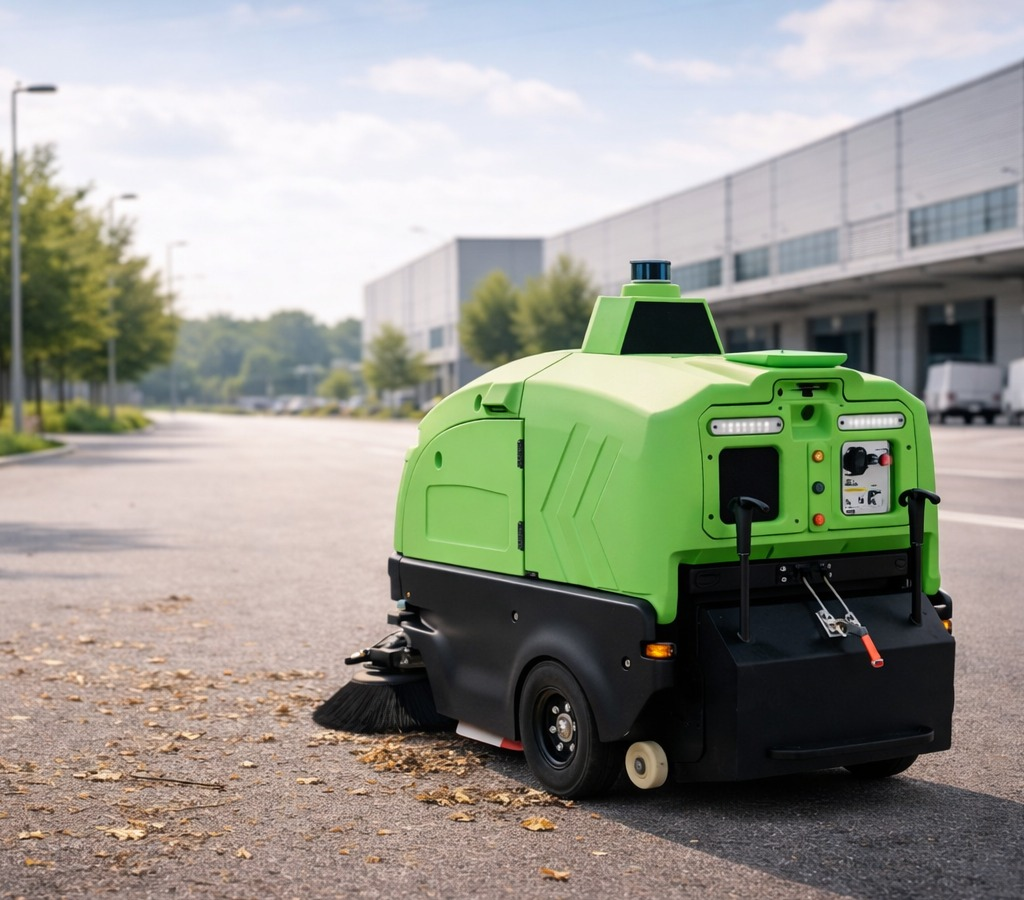
The YJ80 and YJ130 are configured for open yards, access roads, and loading zones, adapting to large industrial sites with less deployment effort.
High Cleaning Capacity for Large Industrial Areas
Rated cleaning efficiency offers a starting point for estimating whether equipment can cover the required area within the available maintenance window. Actual output also depends on route complexity, obstacles, debris levels, and operating interruptions.
The Greendorph YJ130 has a stated cleaning width of 130 cm and rated cleaning efficiency of 5,760 square metres per hour. Its average operating time is listed as six to eight hours.
Procurement teams can compare these specifications with the facility’s cleaning area and schedule. It is also worth considering how often the machine needs to stop for waste disposal or other routine tasks.
Estimating realistic coverage helps teams assess whether cleaning can fit within scheduled shifts without disrupting other site activities. This provides a more practical basis for assessing an industrial cleaning machine than relying on headline capacity alone.With a 130 cm cleaning width and up to 5,760 m² per hour, the YJ130 can cover extensive industrial areas within a normal shift.
Full Automation Reduces Routine Manual Work
Automated equipment can handle repetitive sweeping routes across large outdoor areas, allowing staff to focus on inspections and other maintenance tasks. Its value depends on site layout, traffic patterns, and how well operating tasks fit existing procedures.
The YJ130 combines a primary sweeping system with suction, airflow assistance, and misting spray. Its listed functions also include automatic charging, water filling, and garbage dumping. This automation cuts the manual steps between routes, letting staff focus on inspections and maintenance.
Before selecting a model, teams should review how its operating schedule fits shift patterns and site access requirements. Staff will also need clear procedures for monitoring equipment, handling exceptions, and managing areas that require manual attention.
Integrated Dust Control for Outdoor Conditions
Cleaning requirements depend on the materials a facility regularly collects. Fine dust, leaves, gravel, and larger fragments can require different approaches, so buyers should clarify the expected debris types before comparing machines.
Specifications for brush design, suction, airflow, and dust-control features can help narrow the shortlist. For outdoor applications, misting spray can support dust management during sweeping, while suction and airflow assistance contribute to debris collection.
When comparing industrial floor sweepers for sale, procurement teams should check whether the documented cleaning functions match their site conditions. A supplier discussion about typical debris and surface types can help clarify whether the proposed configuration is appropriate.
Lower Operating Cost Over the Equipment’s Life
The initial quotation represents just one part of an equipment investment. Routine servicing, consumable parts, staff training, and equipment downtime can also affect operating costs.
A consistent comparison should cover purchase price, operating time, maintenance requirements, warranty terms, and technical support. Buyers should also confirm whether training, spare parts, and service arrangements are included in the supplier’s offer.
Reviewing these costs over the expected service period gives decision-makers a clearer picture of the resources needed to keep the equipment in regular use.The YJ130 runs fully on electricity, cutting fuel costs and most engine-related servicing, which lowers long-term operating expense.
These details help teams compare proposals on a consistent basis and assess the longer-term value of an industrial cleaning machine.
Dependable Support From the Manufacturer
Equipment selection also involves planning for implementation. Before purchasing, teams should clarify warranty coverage, maintenance procedures, spare-parts availability, and operator training. Assigning responsibility for daily checks, charging, and waste removal can also support smoother adoption.
Greendorph offers automated sweeping solutions for industrial parks and other outdoor environments. Its product range provides a starting point for comparing available equipment with facility requirements.The company also backs its machines with distributor training, warranty, and technical assistance, reducing downtime risk.
Why Procurement Teams Prefer the YJ130
A sound procurement decision connects product specifications with real cleaning needs. Site layout, debris type, rated capacity, automation, operating costs, and supplier support all contribute to equipment suitability.
Evaluating these factors together helps procurement teams compare options consistently and select equipment that aligns with the facility’s workload and documented requirements.
Taken together, large-area capacity, automation, dust control, low running cost, and dependable support are why procurement teams prefer the YJ130 for industrial floor sweeping.