Choosing commercial DTG printers for sale involves more than comparing purchase prices and advertised printing speeds. For apparel manufacturers, custom T-shirt businesses, and print-on-demand providers, machine capabilities and warranty conditions influence production reliability, operating expenses, and long-term profitability. Evaluating these factors together helps buyers identify equipment that matches their workload while reducing the risk of unexpected maintenance costs.
Compare Printing Features With Actual Production Needs
Commercial DTG printers vary in printhead configuration, working area, garment clearance, and production capacity. A machine designed for occasional customized orders may not meet the requirements of a business processing hundreds of garments daily. Buyers should therefore begin with expected order volumes, garment types, artwork complexity, and delivery schedules.
When reviewing DTG printers for sale, specifications should be compared using consistent operating conditions. Printing speeds may vary with resolution, pass count, artwork coverage, and garment handling time. A supplier’s maximum speed does not necessarily represent achievable output throughout a normal production shift.
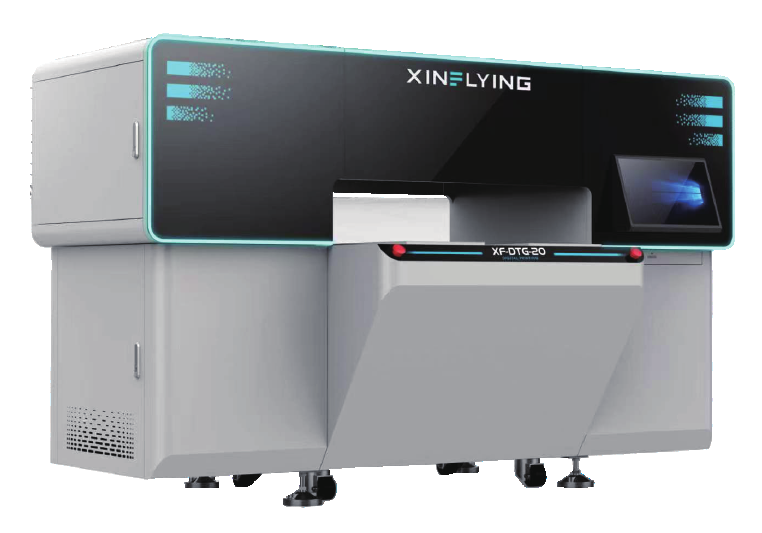
The Xinflying XF-DTG-20 is an all-in-one direct-to-garment solution that combines automatic pretreatment and printing. Its dual-station configuration allows operators to prepare one garment while another is being printed, helping reduce idle time between jobs. This arrangement can be valuable for businesses handling recurring custom-apparel orders.
Examine Printheads, Protection, and Ink Management
Printhead technology directly affects image detail, color consistency, maintenance requirements, and replacement expenses. Buyers should verify the installed printhead model, compatible inks, recommended operating conditions, and availability of replacement components before committing to a machine.
The supplied XF-DTG-20-2I16A1+4I32A1 configuration highlights dual suction, an infrared height-limiting sensor, printhead anti-collision protection, and voice alerts for low ink levels. These features can help operators identify potential problems and protect equipment during routine production.
However, buyers should confirm the exact printhead arrangement and included features against the quotation for their selected configuration. The publicly listed XF-DTG-20 model specifies four Epson i3200-A1 printheads, so its configuration should not automatically be assumed to match every similarly named variant.
A qualified Xinflying DTG printer manufacturer should provide a model-specific specification sheet and explain which components are standard, optional, or configuration-dependent. This documentation helps purchasing teams avoid discrepancies between advertised features and delivered equipment.
Understand What the Warranty Actually Covers
A warranty can reduce financial exposure when equipment develops a covered manufacturing defect, but its value depends on the exclusions and claim procedures. Buyers should distinguish the warranty period from the scope of coverage.
Xinflying’s published warranty policy lists a 12-month limited warranty for eligible DTG, DTF, UV, sublimation, and heat-press machines. Consumables are excluded, and printheads are not covered after installation and successful testing. The company also describes a separate lifetime repair and technical assistance policy, subject to its stated exclusions and conditions. Buyers should obtain written confirmation of the warranty and service terms applicable to their specific model and order.
Before purchasing DTG printers for sale, request written confirmation of the warranty start date, covered components, replacement-part arrangements, and any labor or shipping charges. It is also important to establish whether the warranty applies to purchases made through distributors as well as direct orders.
These details are especially important for businesses that depend on daily production. A warranty covering major mechanical or electrical components may provide meaningful protection, but it should not be interpreted as comprehensive coverage for every printing problem.
Evaluate Technical Support and Maintenance Services
Warranty coverage is only one element of after-sales service. Installation guidance, operator training, troubleshooting assistance, and access to spare parts can influence how quickly a business recovers from equipment problems.
Professional Xinflying DTG printer manufacturer should explain the available support channels and the information required to diagnose faults. Buyers should ask whether remote assistance is included, how replacement parts are supplied, and whether on-site service is available in their region.
Routine maintenance also deserves attention. DTG printing involves ink circulation, printhead cleaning, pretreatment management, and appropriate curing procedures. Operators who follow the manufacturer’s instructions can reduce avoidable interruptions, although maintenance cannot eliminate every mechanical or electronic failure.
For international buyers, time zones, customs procedures, and local technician availability may affect repair turnaround. Clarifying these arrangements before ordering helps businesses plan backup capacity and set realistic customer delivery commitments.
Calculate the Total Cost of Ownership
The initial quotation rarely represents the complete cost of operating a commercial printer. Ink, pretreatment liquid, cleaning supplies, replacement parts, electricity, labor, and maintenance all contribute to ongoing expenses. Garment rejection rates and downtime can further reduce profitability.
When comparing DTG printers for sale, buyers should calculate the expected cost per saleable garment rather than focusing exclusively on equipment price. Requesting sample prints and testing representative fabrics can help establish realistic estimates for ink consumption, image quality, and production time.
Warranty exclusions should be included in this calculation. If printheads are not covered, the business needs a maintenance budget that accounts for potential replacement costs. Similarly, buyers should clarify which consumables are recommended and whether using incompatible supplies could affect warranty eligibility.
A lower-priced machine may still be a sound investment, but only when its production capacity, service arrangements, and operating expenses align with the business’s financial targets.
Verify the Supplier and Purchase Documentation
Reliable purchasing decisions depend on transparent documentation. Before placing an order, businesses should request the complete specification sheet, warranty policy, installation requirements, consumables list, and delivery terms. The quotation should identify the precise model and configuration rather than relying on a general product name.
Working with an established Xinflying DTG printer manufacturer can give buyers access to product documentation and technical guidance, but the specific commitments should always be confirmed in writing. Buyers should also retain invoices, serial numbers, commissioning records, and communications related to warranty coverage.
These records make it easier to establish eligibility for repairs and resolve misunderstandings about included accessories or promised services.
Make a Confident Long-Term Equipment Decision
Selecting commercial DTG equipment requires balancing printing performance, operational safeguards, warranty coverage, and after-sales support. Buyers who assess these factors together can make better purchasing decisions and reduce the likelihood of unexpected production costs.
Before choosing a machine, businesses should verify its exact configuration, review warranty exclusions, and estimate total ownership costs. By comparing documented specifications and service commitments rather than relying on headline prices alone, apparel businesses can select equipment that supports dependable production and sustainable growth.